Monday, September 14th, 2026
What happens when you give a child the chance to learn in a garden? Since 2006, Garden to Table has been helping schools use gardens as outdoor classrooms where students can connect what they are learning in the classroom to the world around them. Today, the organization partners with 18 elementary schools, engaging students in hands-on, experiential learning rooted in science, sustainability, food and community.
But perhaps most importantly, Garden to Table is creating opportunities for kids to experience something that can be surprisingly rare in a structured school day: getting outside, getting their hands dirty and discovering something for themselves.
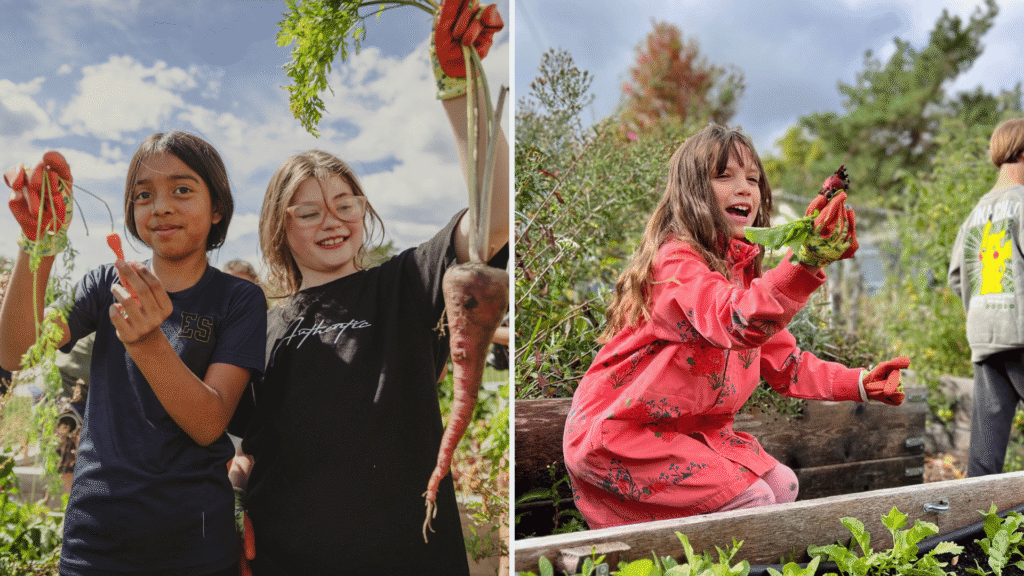
“There is something really magical about being in the gardens with the kids when they pull a carrot out of the ground for the first time,” said Lindsey LeCuyer, Executive Director. “There’s nothing like it.”
The organization has intentionally developed its curriculum to connect with what students are already learning in their classrooms and to align with BVSD curriculum and the Next Generation Science Standards. A second grader studying insects, for example, might head into the garden for an insect scavenger hunt. Students also take on meaningful responsibilities that contribute to the health of their school garden, from planting and harvesting to helping winterize the garden at the end of the season.
By the time students move through their elementary school years, they have had repeated opportunities to learn outdoors while contributing to a shared space in their school community.
“I just think there’s all these really cool connections that gardens can make with students that are going to stick with them forever,” shared Courtlyn Carpenter, Community Outreach Director. “It’s really inspiring work, and it feels great to be bringing the next generation up with these experiences and these connections.”
As Garden to Table has grown, so has its focus on making sure every student has consistent access to the program.
The organization currently serves six Title I schools, nearly all of the Title I elementary schools in BVSD, and has been gradually shifting toward a garden educator-led model. This year, Garden to Table has three garden educators on staff, providing lessons at half of its partner schools, including all of its Title I schools.
The shift grew out of a practical challenge: relying entirely on volunteers can make programming difficult to sustain. Volunteers move on as their children graduate, jobs change and schedules get busier. While volunteers remain an important part of Garden to Table’s work, having dedicated educators creates consistency and helps ensure that students across the district receive the same high-quality experience.
“It’s so much easier to just have the consistency of our educators who know our gardens and know the lessons well,” said Carpenter. “And we know the students are getting delivered the same great material.”
Additionally, two of Garden to Table’s educators are bilingual, allowing lessons to be taught in both English and Spanish at bilingual schools.
“Which makes a big difference,” shared LeCuyer. “You have some kids who aren’t just sitting in the back waiting for a teacher to translate for them. They’re able to fully participate.”
Like any organization working closely with public schools, Garden to Table has to be ready to adapt.
“We have to ride through whatever challenges public schools are facing,” LeCuyer said. “Sometimes that involves some additional funding and staff time to manage that or pivoting and shifting what we’re doing.”
Climate change brings another layer of unpredictability. Growing food is never completely predictable, and increasingly, students are learning that firsthand. But even when the cucumbers don’t cooperate or the beans fail to take off, there is a lesson to be learned.
“We’re taking the kids out there and showing them how this happened, why this happened, how they can help,” shared LeCuyer. “We present a challenge that’s also a learning opportunity.”
As far as successes, Garden to Table recently received its second USDA Patrick Leahy Farm to School Grant, building on its first grant and supporting the continued expansion of its garden educator model. For LeCuyer the recognition was both exciting and meaningful.
“I almost hit the floor when I got that email,” shared LeCuyer. “It feels really affirming about our work.”
The organization also launched its first board-directed Sustainability Fund in honor of its 20th anniversary, raising $70,000 to create a reserve to support long-term sustainability.
But Garden to Table knows that grants alone cannot sustain this work. About 85% of its work is fundraised, and the organization is looking for long-term support from the local community to ensure that garden-based learning remains available to all students in the Boulder Valley School District. Community members can get involved by volunteering, serving as garden lesson chaperones, making a monthly donation or attending the annual Boulder Garden Tour fundraiser.
As National School Garden Month approaches in October, Garden to Table will keep planting, teaching, harvesting, adapting and inviting kids into the garden to discover what happens when learning comes to life.
Because sometimes, all it takes is a carrot pulled from the ground to make a little magic.
To get involved or to learn more visit: gardentotable.org or email courtlyn@gardentotable.org